


How to identify a good AI use case: a step-by-step guide for successful AI implementation

Many teams are implementing AI because it is the hot, new shiny object. Your board wants to know – “what is your AI strategy?” Your boss says – “we need to slap AI on this product”. By now, you are probably exhausted of this endless hype cycle without seeing any actual results. Most AI projects fail. The secret for you to please your boss, your board and your business lies in how to identify a good AI use case based on your organization’s AI maturity.
Key takeaways
- AI is just a tool in our technology toolkit. AI should be implemented with a specific business impact in mind, not just because it is the sexy new thing.
- Identifying an appropriate AI use case requires assessing both data reliability and people readiness.
- The best AI use cases are high business impact with limited non-AI solutions, accessible data and a team that is willing to embrace it.
- Workshops can help identify and score potential AI use cases for strategic success.
Why most AI projects fail
Despite the growing popularity of AI, most AI projects fall short of expectations due to lack of trust. You might know that you need to use AI but struggle with where to begin. Your company aims too big and bites off more than is possible to accomplish. You don’t have the data ready to do anything with AI. Or the end users are scared that AI is going to replace them.
The key to overcoming this problem is choosing the right AI use case. If you understand what makes a good AI use case, you will be able to succeed.
How to start: the importance of small wins
Small wins build momentum. Starting with low-risk, high-impact AI projects helps you gain confidence in the technology. It ensures that teams are onboard and ready to support further projects. If you don’t focus on small, manageable successes that you can promote internally, you risk a common AI project problem, which is working on an overly complex and ambitious project that sounds incredible on paper, but ultimately is guaranteed to fail.
Key characteristics of a good AI use case
A good AI use case should align with the following principles:
- Low stake, high gain: Prioritize projects that have the potential for a high return on investment without significant risk.
- No viable alternative: AI should be the only feasible solution for the problem. If you can use a different technology to achieve the same result, use that. It will likely be cheaper and safer.
- Direct business Impact: Projects should tie directly to measurable business goals and metrics.
- Data availability: You need to be able to access the data that will power this project. That means you. Many projects fail because of siloed organizations which means that the team executing the project is missing a key piece of data that is buried in another part of the organization.
- People readiness: Is your team or the people who will be using this ready for AI? If they are not, is there a path to bring them along gradually without scaring them?
AI is simply a tool in the technology toolkit, so it’s important to apply it where it will make a tangible difference rather than just because it’s the latest trend.

Evaluating business impact
Before you slap AI on to the project, map out the business impact that the project aims to achieve. This ensures that the effort is strategically aligned and not merely AI for the sake of AI. Key questions to ask include:
- What business problems does this AI project address?
- What metrics and levers can the project influence?
- How will success be measured?
Data reliability and people readiness
A successful AI project depends heavily on two critical factors: data reliability and people readiness.
Understanding data reliability
Data is the backbone of any AI project. To ensure a high likelihood of success consider these six aspects:
- Traceable sources and security: Data should come from reputable, secure sources.
- Quantifiable quality: Data quality should be measurable and consistent.
- Statistically significant volume: Sufficient data volume is required to train reliable AI models.
- Appropriate access: Ensure access to data, as siloed data can hinder AI implementation.
- Sufficient availability: The data should be readily available when needed.
- Adequate freshness: For projects that require real-time or up-to-date information, data freshness is vital.
Assessing people readiness
Even if the data is reliable, the project will fail if people aren’t ready. This refers to how ready your team and end-users are to adopt AI solutions. Important factors to evaluate include:
- Sufficient privacy and transparency: Respect for data privacy and transparency builds trust.
- Outsized business value: Projects should demonstrate significant business value to motivate adoption.
- Deep domain knowledge: Teams need relevant domain expertise to guide the AI project’s implementation.
- Team credibility: Credible teams are more likely to gain support and resources.
- Viable risk mitigation: Have strategies to mitigate risks associated with the project.
- Overall readiness: Assess the team’s willingness to embrace changes brought by AI.
The quadrant model for AI use case evaluation
By plotting data reliability against people readiness, use cases fall into four quadrants:
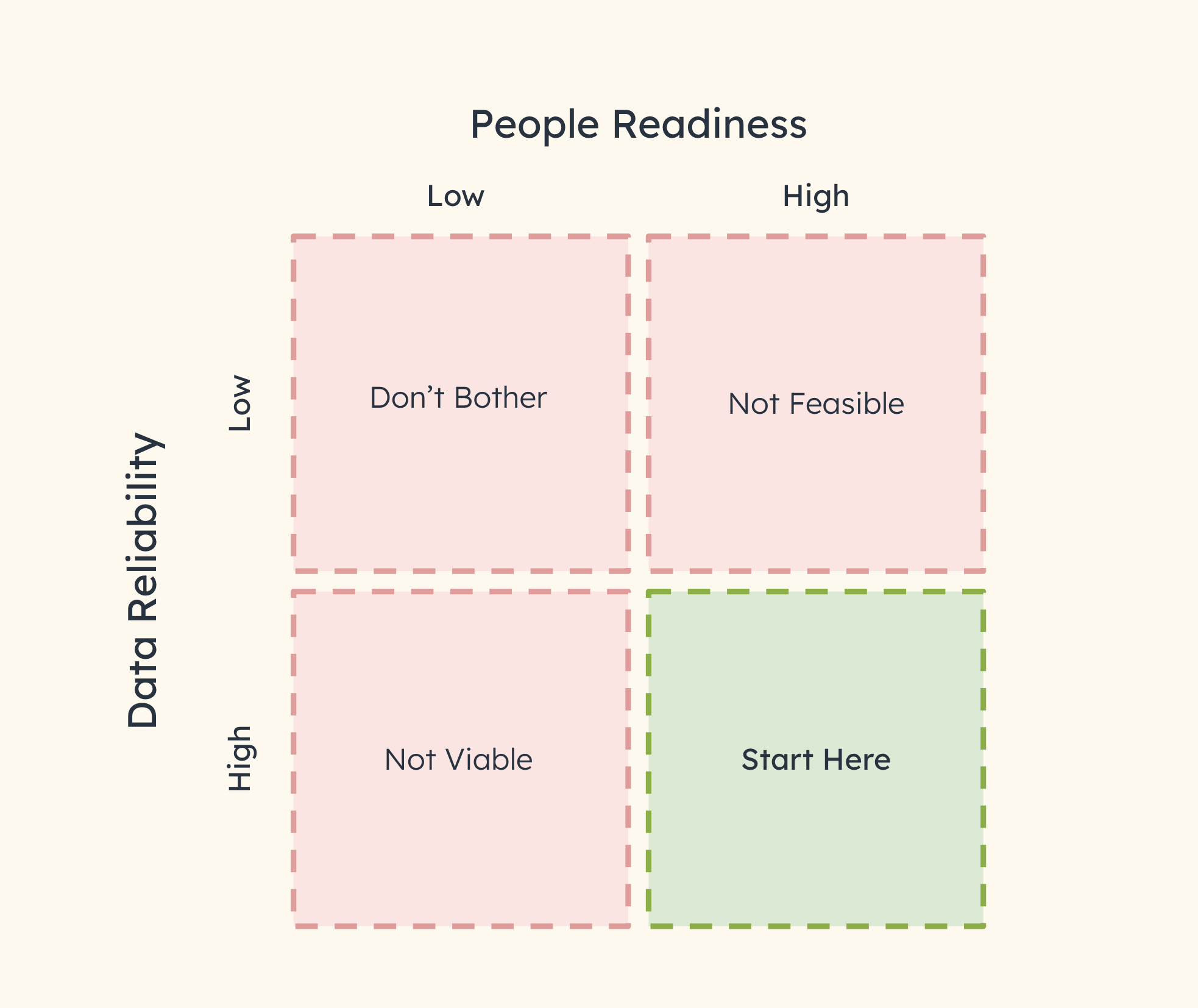
Low Data Reliability, Low People Readiness: don’t bother
If both data and people are not ready, avoid pursuing the project. It’s not worth the effort until these factors improve.
Low Data Reliability, High People Readiness: not feasible (yet)
Even if people are ready, unreliable data makes it difficult to justify the project’s feasibility. Keep these use cases in mind for future exploration as data cleaning can take time. By showing wins in other areas, leadership will be keen to invest in the cost of improving data quality in other parts of the business.
High Data Reliability, Low People Readiness: not viable
While good data is essential, if the people involved are not ready, the project will not succeed. Consider revisiting these use cases once you’ve built momentum with easier wins. Once you have those wins under your belt it will be easier to show other groups why this is not something to be scared of and how to embrace it.
High Data Reliability, High People Readiness: start here
This is the ideal quadrant for launching your AI journey. When both data reliability and people readiness are high, the project has the highest chance of success.
Finding the right AI use case workshop
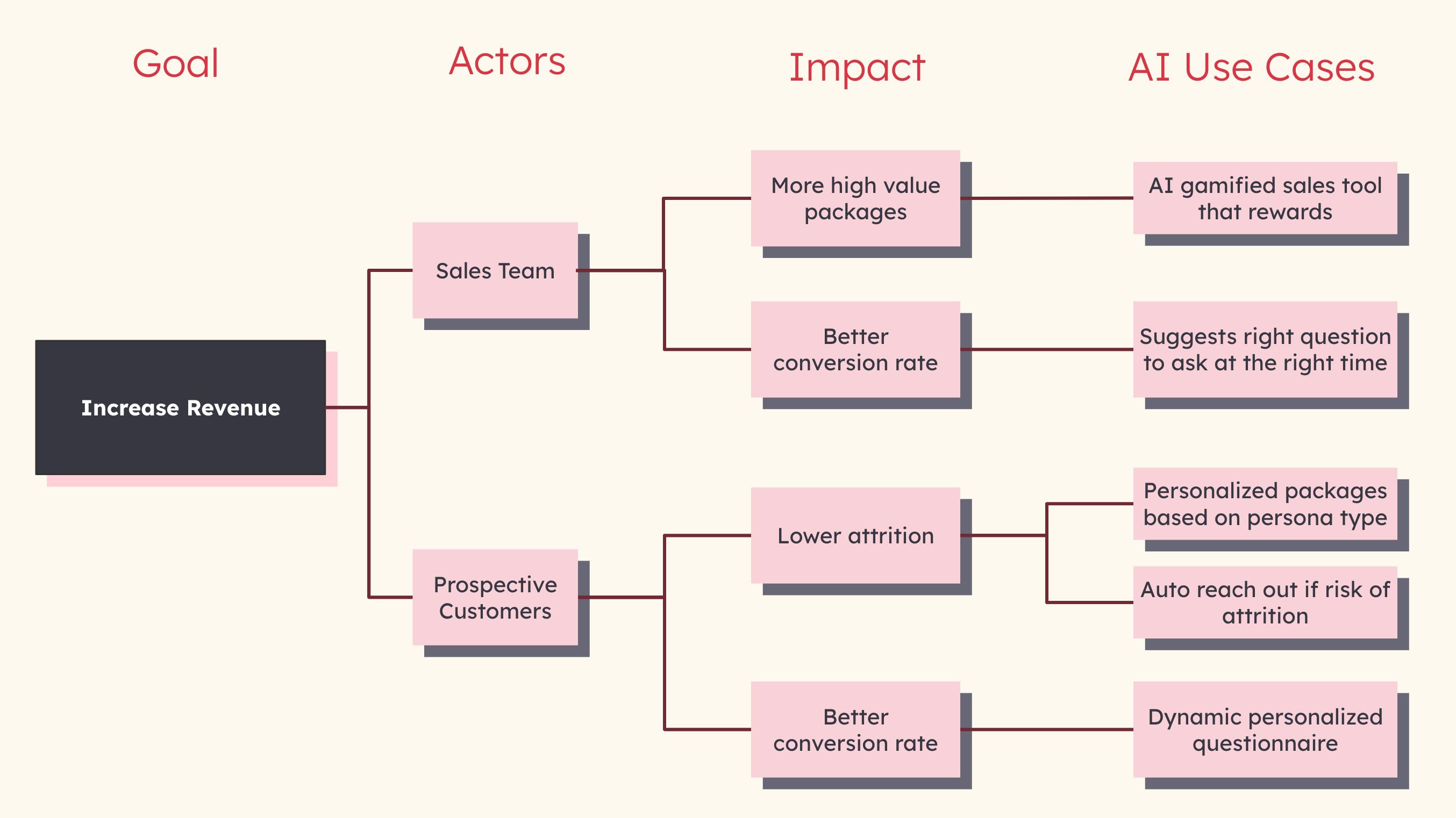
To identify the right AI use case, we start with an impact mapping workshop. During the workshop:
1. Outline Goals
Define the big business goals you want to target. These goals are typically tied to one of three major buckets:
- Direct Financial Gain (Increased revenue or reduced costs)
- Operational Efficiency (Faster time-to-market or quicker issue resolution)
- Customer Experience (Increased satisfaction scores or improved retention)
2. Identify Actors:
List out the people who can influence those goals. Think about your specific personas. Answer questions like:
- Who are the actors who can affect either positively or negatively each step?
- This can be both specific roles within your organization as well as specific types of customers?
Be specific if it makes sense. Don’t forget back office roles who you could build tools for.
3. Determine Impacts
Identify which metrics and levers can be influenced by your actors.
- What IMPACT can each ACTOR have?
- How can each ACTOR help us?
- What is the specific behavior that will improve our chance of success at our goal?
This is much different from typical modeling of user behavior, as it is all goal-oriented versus focusing on the tasks people are trying to accomplish.
4. Generate use case ideas
Brainstorm use cases that can impact these metrics that could incorporate AI.
- What are potential things we could build to make this impact?
- How can AI help make an impact?
Think outside the box. Try to stretch your imagination on potential solutions or areas. This will be the use cases that we ultimately prioritize.
This structured approach ensures that the resulting AI ideas are directly tied to business outcomes, avoiding projects that exist solely for novelty.
Scoring AI ideas: impact, data reliability and people readiness
After brainstorming potential use cases, score each idea based on:
- Impact: How much value does it provide? How confident are you in its ability to make a difference?
- Data Reliability: How quickly and efficiently can you access quality data for this use case?
- People Readiness: Are the teams ready to use and support the AI solution?
This scoring method helps prioritize use cases, guiding companies toward projects with the highest likelihood of success. You can ultimately determine what weighting you want to give to each of these sections.
Identifying the right AI use case is a strategic process. By focusing on high-impact, low-risk projects, assessing data reliability and people readiness, and conducting impact mapping workshops, companies can lay the foundation for successful AI initiatives.
It often helps to have an outside team help facilitate these workshops to make sure everyone is heard and bring in a diverse group of ideas. We love hosting these workshops, so get in touch if you want help.
FAQs
1. Why is data reliability so important for AI projects?
Reliable data ensures that AI models are trained on accurate, consistent, and relevant information, which directly impacts the model’s effectiveness.
2. How can I assess my team’s readiness for AI adoption?
Evaluate the team’s domain expertise, willingness to adapt, understanding of AI benefits, and ability to manage potential risks.
3. What is an impact mapping workshop?
An impact mapping workshop is a strategic planning session where business goals, actors, and metrics are mapped out to identify viable AI use cases aligned with desired outcomes.
4. Can I start an AI project if data reliability is low?
If this is your first AI project, avoid it! Focus first on improving data quality and accessibility before pursuing AI projects.
5. What if a high-impact AI use case has low people readiness?
In such cases, work on building trust, providing training, and addressing concerns before implementing the AI solution. You can also look at improving the user experience so the AI is hidden or builds trust.
6. How do I measure the success of an AI project?
Success should be measured based on predefined business metrics, such as increased revenue, improved efficiency, or enhanced customer satisfaction.


Stay up to date with InfoBeans
Get insights from our team of experts who deliver digital software day in and day out.
 Thank you for signing up!
Thanks a lot for your interest. You are already a subscriber. You will receive your first newsletter soon.