


Application modernization - How to start

Application portfolios gradually lose business fitness, innovation support, and agility while becoming increasingly expensive, complex, and risky to maintain. Not only this, but it also makes applications vulnerable to malicious attacks. Application modernization is an answer to all these problems.
Modernization not only keeps organizations competitive but also enables prompt decision-making. It offers a distinct edge in responding to market demands swiftly by capitalizing on scalability, security and a well-designed microservice architecture.
As per Market Research Future (MRFR), “The market for application modernization is projected to reach a market value of $24.8 billion by 2030, growing at a CAGR of 16.8% from 2022 to 2030.”
It is always recommended to keep our applications updated, including the hosting environment, security patches and utilizing the benefits of the latest technologies.
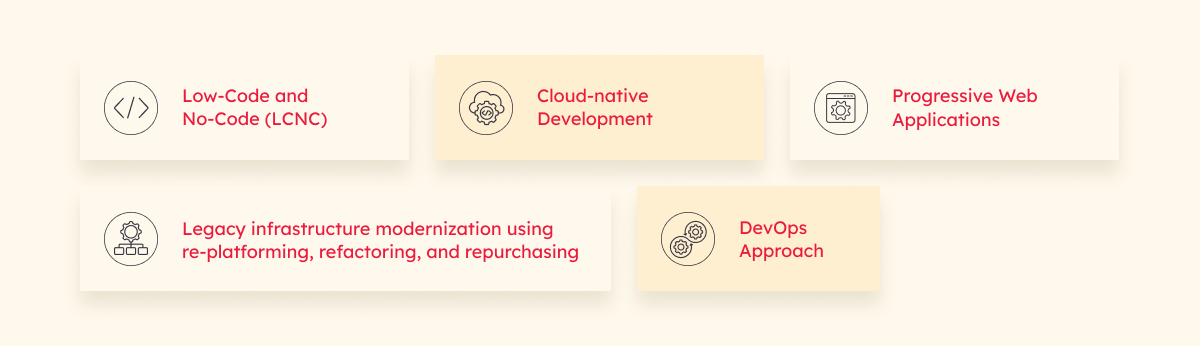
These trends accelerate the application modernization journey as a part of digital transformation.
While on the journey towards application modernization, a business owner and software engineer leader grapples with a lot of questions. Let us look into them and find answers.
How do I start with application modernization?
Starting with application modernization involves a series of strategic steps to ensure a smooth transition while maintaining business continuity. Here’s a structured approach to get you started:
Start with database services
- Study the modules and databases used and identify the best suited cloud based services, either SQL managed instances or Azure SQL PaaS services, based on your application requirements. This step will help you move away from on-premise database servers and hardware maintenance to cloud-based service adoption.
- Identify areas where NoSQL databases can be leveraged for handling unstructured data, enhancing performance, and capitalizing on the advantages offered by NoSQL technology.
Storage movement
- Legacy platform applications often rely on directories or server hard drives rather than leveraging modern cloud storage solutions like Azure Blob. However, embracing cloud-based storage services can revolutionize operations, not only saving time and improving performance but also enhancing data security, scalability, and accessibility. This transition represents a pivotal step towards modernizing infrastructure, enabling greater flexibility, reliability, and cost-effectiveness in storage management.
- Maintenance of storage is easy with cloud services. You can use life cycle management for better utilization of documents in use and archive or delete by defining the rules as per the requirements (Example: delete documents older than 30 days or change the tier)
Hosting environment
Once we are done with the storage and database approaches, the next target will be the upgrade or movement to cloud-based hosting services. Simplified hosting services are good to start with, such as the Azure static app, which is one of the best and most optimized cloud hosting services for deploying your applications
What if we are already on the cloud and following the above steps?
By following the aforementioned steps, you can certainly reduce costs and embark on your path towards app modernization without significantly disrupting your current business plans. However, this is only the beginning of the journey, and the pursuit of app modernization continues.
What next?
Serverless
Many developers transition to serverless gradually, shifting certain components of their application to serverless while keeping other parts on traditional servers. Serverless architectures are easily extensible, so you can always introduce more functions as opportunities arise.
Every application has functionalities where it requires background running tasks, services and jobs. These are the first target areas to move towards serverless, utilizing Azure functions, durable functions and messaging services to make your solution serverless.
Jobs and background services are not the only areas; applications’ user facing operations and actions can also be divided into smaller components, and high computation and time taking activities can be passed on to serverless by following various patterns, and we can get full benefit from cloud computing.
If you have the scope and opportunity to re-architect and rebuild:
Microservices
Building upon the previously discussed solutions, organizations may explore the adoption of microservices when there’s potential for reconstruction, redesign, or the integration of new components, provided they align with their objectives. Embracing serverless architecture presents opportunities for heightened control, adaptability, and scalability. This approach fosters applications characterized by inherent modularity and fluid interconnections across various domains and modules.
- Modular development: Breaks down applications into smaller, manageable services
- Scalability: Allows for independent scaling of services based on demand
- Technology diversity: Supports the use of different technologies for different services
- Fault isolation: Minimizes the impact of failures by isolating them to specific services
- Rapid deployment: Enables quicker development cycles and faster time-to-market
- Team autonomy: Facilitates decentralized development and ownership of services
Conclusion
In conclusion, application modernization isn’t just a trend; it’s a strategic imperative for businesses aiming to thrive in the ever-evolving digital landscape. By embracing modernization initiatives, organizations can unlock new levels of efficiency, agility, and competitiveness, ensuring they remain at the forefront of innovation. As we look to the future, investing in app modernization will undoubtedly prove to be a cornerstone for sustainable growth and success in the digital age.


Stay up to date with InfoBeans
Get insights from our team of experts who deliver digital software day in and day out.
 Thank you for signing up!
Thanks a lot for your interest. You are already a subscriber. You will receive your first newsletter soon.